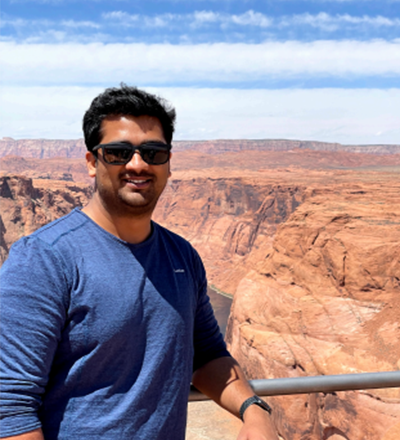
Hi, I'm Aayush Gupta 👋
PhD in Computer Science specializing in distributed algorithms, machine learning, and cybersecurity.
- Sunnyvale, California, USA
- Software Engineer at Google Cloud
Curious about me? Here you have it:

I am a passionate researcher with a PhD in Computer Science from the University of Houston. My work bridges theoretical computer science with practical applications, focusing on distributed algorithms, network resilience and machine learning. I enjoy exploring the intersection of high‑performance computing, cybersecurity and artificial intelligence.
Currently, I am applying this expertise at Google, where I build advanced machine learning models and data pipelines to automatically diagnose hardware failures across large-scale computing infrastructure. By integrating diverse performance metrics and sensor data, and designing analytics to track maintenance patterns, I help develop proactive systems that ensure precise, first-time fixes. This work minimizes manual troubleshooting and keeps our massive computer networks running at peak efficiency.
Prior to my PhD, I completed my MSc at the University of New Mexico and earned a B.Tech. in Electronics & Telecommunication. Along the way I interned at national laboratories and tech companies, gaining experience in data science, network analysis and software engineering. In my free time I share knowledge through teaching, mentoring and open‑source contributions.
The skills, tools, and technologies I am really good at:
A quick summary of my most recent experiences:
Google Cloud
I work on building advanced machine learning models and data pipelines that automatically diagnose hardware failures in large-scale computing infrastructure.
Pacific Northwest National Lab
Developed data analytics and machine learning models for high‑performance computing applications, optimizing workflows and visualizing results.
Center for Advanced Research Computing
Researched parallel algorithms and implemented prototypes in distributed computing environments using Slurm and MPI.
Selected research papers and results
Fully-Distributed Construction of Byzantine-Resilient Dynamic Peer-to-Peer Networks
Full paper presenting a fully-distributed protocol for constructing and maintaining Byzantine-resilient, sparse P2P overlays with high expansion and low diameter under stochastic churn. Includes theoretical guarantees and empirical evaluation.
↗Energy-Efficient Maximal Independent Sets in Radio Networks
Introduces algorithms for computing maximal independent sets in radio networks that significantly reduce energy usage while preserving strong theoretical guarantees. Published in DISC 2025 with a corresponding PODC ’25 brief announcement.
↗Wake Up and Join Me! An Energy-Efficient Algorithm for Maximal Matching in Radio Networks
Proposes a randomized algorithm for maximal matching in radio networks that optimizes both running time and energy consumption, with results presented at DISC ’23 and a brief announcement at PODC ’21.
↗Selected posters and invited talks
Software Vulnerability Detection: A Grand Challenge for AI
Poster on the challenges of building robust and generalizable software vulnerability detection systems, highlighting dataset issues, evaluation pitfalls, and directions for future research.
↗Fully-Distributed Construction of Byzantine-Resilient Dynamic Peer-to-Peer Networks
Conference talk at SPAA ’25 presenting a fully-distributed protocol for constructing sparse, high-expansion P2P overlays that are resilient to Byzantine failures and churn.
↗Comparative Analysis of Approaches to Software Vulnerability Detection on High-Quality Datasets
Poster presented during the U.S. DOT CYBER-CARE OST-R visit, showcasing empirical results for DistilBERT and TextRCNN on MVDSC and NVD datasets for software vulnerability detection.
↗Some of the noteworthy projects I have built:
Facial Expression Recognition
Built a machine learning pipeline to recognize facial expressions using HOG and Gabor features. Combined classical classifiers and CNNs with ensemble methods to boost accuracy.
↗Natural Language QA System
Designed a question‑answering system with the CommonsenseQA dataset, fine‑tuning RoBERTa models and engineering pipelines to achieve competitive accuracy.
↗Code Clone Detector
Implemented a machine learning framework that detects code clones using neural networks, training on BigCloneBench and leveraging graph representations.
↗What’s next? Feel free to reach out to me if you're looking for a collaborator, have a question, or simply want to connect.
You may also find me on these platforms: